
We Promise This Isn’t Another Election Email
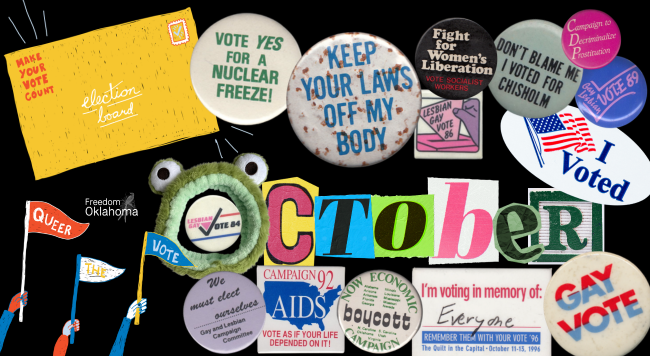
To exist in October of an election year is to be bombarded with election asks at every turn. My inbox, my mailbox, my text messages, my voicemails…no avenue is safe from outreach telling me about how some candidate is good or terrible or promises to fight for me or hate me or maybe remember that I exist if I can just spare $5. And it’s exhausting. Particularly when harm seems to amplify with each election cycle, but change and meaningful allyship and community investment come at a much slower pace. So, this isn’t another election e-mail. It’s a reminder of the world we’re fighting for, rooted in the long history of 2SLGBTQ+ folks acting up, taking on care work, and building the world we want one ballroom, one AIDS clinic, one art installation, one zine, one playlist, one movie night, one book club, one top surgery fundraiser, one organizing meeting, one act of kindness at a time.
Dragons, hobbits, and the business of freedom
By all accounts, we’re writing you from the dragon’s den, folks. We already know the outcomes of most people’s election day and policy fears, because we’ve been living in the aftermath for years now. The despair weighs heavy across community as the dragons in power hoard wealth alongside the tally of harms they have caused us to keep themselves in power, to keep the systems moving. But yet, we stay focused on the business of freedom.
When September Ends, on the music that shaped me, questioning empire, and the fight for liberation
I was a few months shy of 12 years-old when 9/11 happened. I remember so much of that day and its aftermath very clearly, including the (now baffling) decision of our teacher to take us down to the library to let our class watch news updates in real time, even as one of my classmates sobbed in distress, not knowing if her aunt had gone to work at the World Trade Center that day. That year our school Christmas performance was altered to a God Bless the USA theme. And more and more, as a youth coming into my own political perspectives (which were anti-war even then), I realized that I did not quite fit in with most of my classmates' perspectives about the American response in the aftermath of 2001.
Has it really (only) been five years?
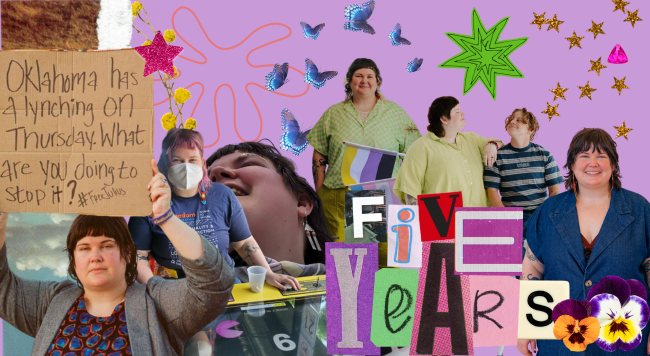
A lot has changed in the last five years. But one thing that hasn’t is that so many of you invest in the work to build a future where all 2STGNC+ folks have the safety, resources, and community to thrive, in and beyond Oklahoma.
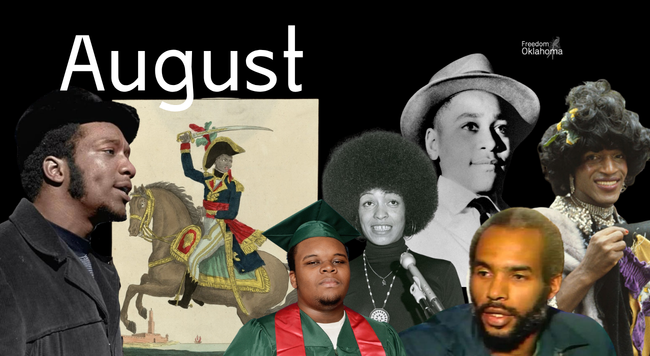
Black August
Since 1979, Black August has honored the Black political prisoners, Black freedom fighters, and efforts for Black liberation. Originally attributed to honoring the August deaths of Jonathan and George Jackson, though August also marks several key dates in the fight for Black revolutionary moments, along with the birthdays of many Black revolutionaries including Debbie Sims Africa of MOVE (Aug 4), Mutulu Shakur (Aug 8), Marcus Garvey (Aug 17), and Fred Hampton (Aug 30).
The Safety to Rest
Because movement building is nothing if not an experiment in building the infrastructure for the future we deserve.
This Land We Call Home
In one of Frederick Douglass’s many brilliant orations, he posed the question, what to the negro is the fourth of July? It’s something I think about this time of year more and more. If you’re newly grappling with disentangling yourself from the myth of this nation on the Fourth of July, I offer you this…
Freedom Oklahoma responds to Supreme Court Rulings in BPJ and Hecox
his morning, the Supreme Court of the United States issued its ruling in two cases — West Virginia v. B.P.J. and Little v. Hecox — brought to the Supreme Court by states defending categorical bans on transgender women and girls participating on women’s and girls’ sports teams. The Supreme Court upheld anti-trans sports bans enacted in Idaho and West Virginia, holding that these laws do not violate either Title IX or the Equal Protection Clause.
In response to the rulings, Freedom Oklahoma issued the following statement, attributable to Cole McAfee (they/them), Executive Director…
Roll for Initiative
Being a small organization (we currently have 2 full time staff, and 2 paid interns) can present a grave disadvantage for the quests set before us. And, it also allows us to be nimble, and get creative with how we craft fellowship and approach obstacles.
Invest in changing the narrative for trans+ Oklahomans
The most recent Resource Tracking Report produced by Funders for LGBTQ Issues shows that for every $100 awarded by U.S. foundations in 2023, only 3.5 cents supported transgender, gender non-conforming, and nonbinary (TGNCNBi) communities, which was a decrease from 4.6 cents per $100 awarded in 2022. And in a state like Oklahoma, we know those disparities hit even harder.